De Bry's engravings of Guiana
DE BRY’S ENGRAVINGS OF GUIANA
I photographed the copperplate engravings below in the 1634 edition of de Bry’s Historiae Americae Sive Novi Orbis (‘History of America or the New World’), including three of Guiana that were first published in the 1599 edition of the eighth volume, and a fourth – the depiction of ‘paradise’ – added later. The engravings were the work of Theodor de Bry and his sons, who took over after Theodor’s death in 1598. Often referred to as the Grands Voyages or Americae, de Bry’s work was hugely influential as a compilation of first-hand accounts of early voyages similar to Richard Hakluyt’s Principal Navigations of 1589.
Hakluyt provided de Bry with copies of John White’s watercolours from the 1585 Roanoke expedition, meaning that the engravings in that part of Americae are based on eyewitness depictions. In the case of the Guiana engravings, made to illustrate a Latin version of Sir Walter Ralegh’s Discoverie of Guiana, we do not know whether sketches were made and brought back from the expedition - though it seems to me highly likely. Even if the images were largely in the imagination of the engravers, there are details such as the headdresses of the indigenous leaders that can only have been made on the basis of eyewitness descriptions or by seeing the artefacts themselves, perhaps in the accoutrements of indigenous people who Ralegh brought back to London.
In the case of Ralegh himself, his appearance in the engravings may be based on first-hand knowledge by Theodor or his sons - if it was Theodor who made these engravings, from his period living in London in 1585-8 when Ralegh was prominent in Queen Elizabeth’s court and would have been a familiar face in London. In general the depictions in the Guiana chapter in Americae show a careful reading of Ralegh’s Discoverie, and are invaluable for understanding the view of this part of the New World that held people’s imagination until the publications of Alexander von Humboldt and Robert Schomburgk in the 19th century.
Click on the images to enlarge.
The title page of the 1634 edition of de Bry’s Historiae Americae, with the chapter on Ralegh’s 1595 expedition represented in the roundel on the lower left (photo: David Gibbins).
The first page of de Bry’s Latin version of Ralegh’s Discoverie of Guiana, by ‘Gvalthervm Ralegh’ and beginning ‘Anno 1595. die Iouis 6. Februarii …’ (photo: David Gibbins).
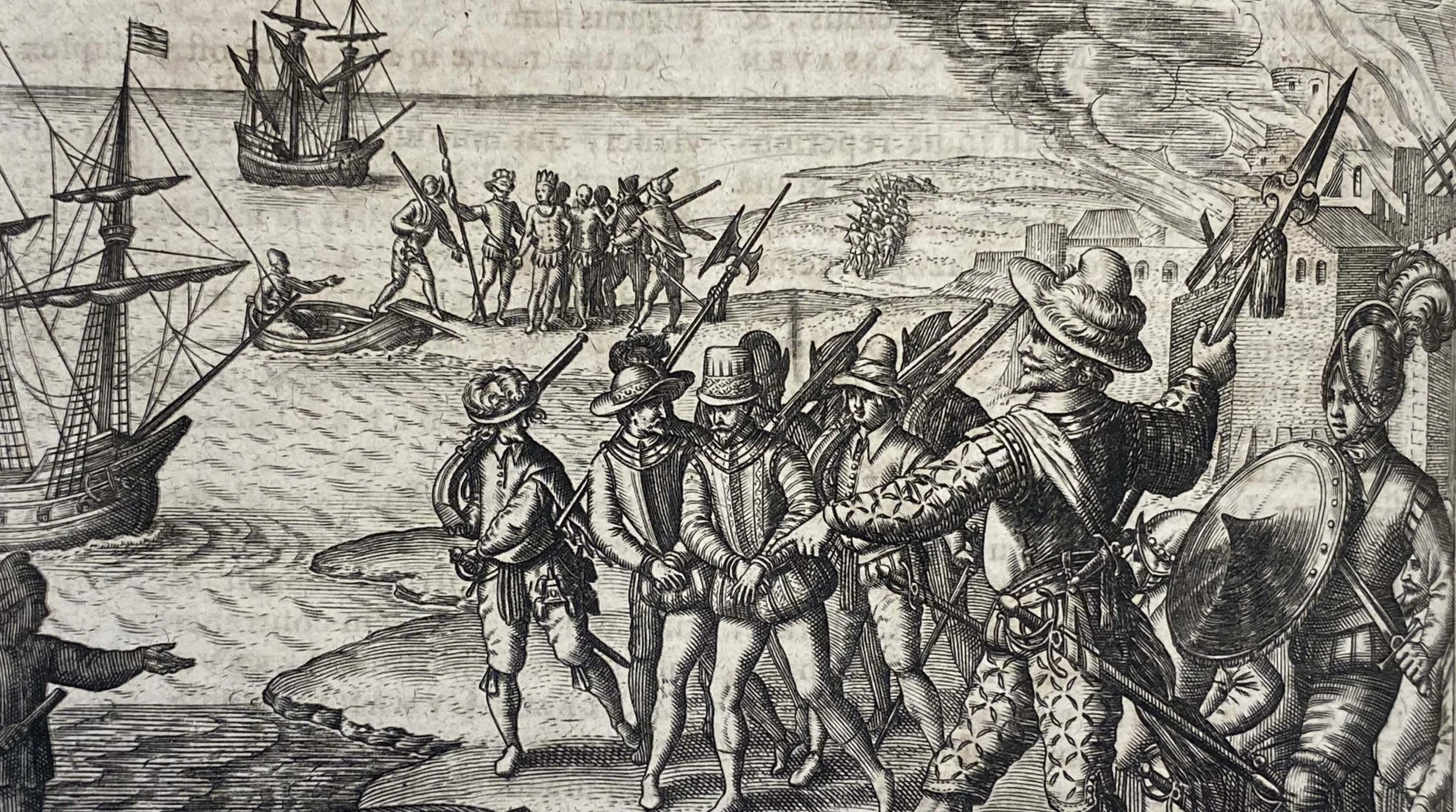
De Bry’s engraving of Sir Walter Ralegh and his men in 1595 capturing Antonio de Berrio, the Spanish governor of Trinidad who himself had searched for El Dorado and was to give Ralegh valuable intelligence. The Spanish settlement can be seen burning to the right and in the background are several indigenous leaders, ‘cassiques’, one with a distinctive feather headdress. The ships give a good idea of the appearance of the small seagoing vessels of the expedition, including ‘pinnaces’. Ralegh is resplendent in the clothing and weapons of an English knight of the time, and the image is entirely in keeping with a period when England was at war with Spain - less so when this final edition of Americae was published in 1634 (photo: David Gibbins).
De Bry’s engraving of Ralegh’s men in the Orinoco delta encountering Indigenous people practicing excarnation. The depiction of tree-houses is based on Ralegh’s account - that during winter when the river is high they ‘dwell upon the trees, where they build very artificial towns and villages’ (photo: David Gibbins).
De Bry’s engraving of Sir Walter Ralegh meeting the Indigenous cassique Topiawari in a tent beside the Orinoco river, with people bringing them food for a feast and in the background one of Ralegh’s ships anchored in the river. Topiawari - said by Ralegh to be 114 years old, old enough to have seen Columbus - wears the characteristic feathered headdress of the Guiana chiefs, and Ralegh carries a tube that may contain a map. The tent would not be out of place at a European tournament, but it is quite possible that tents such as this were carried on the ships (photo: David Gibbins).
This engraving from de Bry’s Americae, not in the 1599 edition but added at some point before the final 1634 edition, is in many ways the most beguiling of the Guiana images made to accompany the text of Ralegh's Discoverie. It shows a terrible scene, as described by Ralegh - a lagarthos, a crocodile (though looking more like an anaconda), devouring one of his men. It is a scene of darkness, reminiscent of a medieval image of Hell, but beyond that - in deliberate contradistinction - is another place entirely, lit up by the rays of the sun - a place with an abundance of wildlife and manicured meadows and trees, and seemingly leading upriver to somewhere even more exalted. The engraver has captured Ralegh’s exuberant description of the earthly paradise that he thought he was seeing in Guiana (photo: David Gibbins).