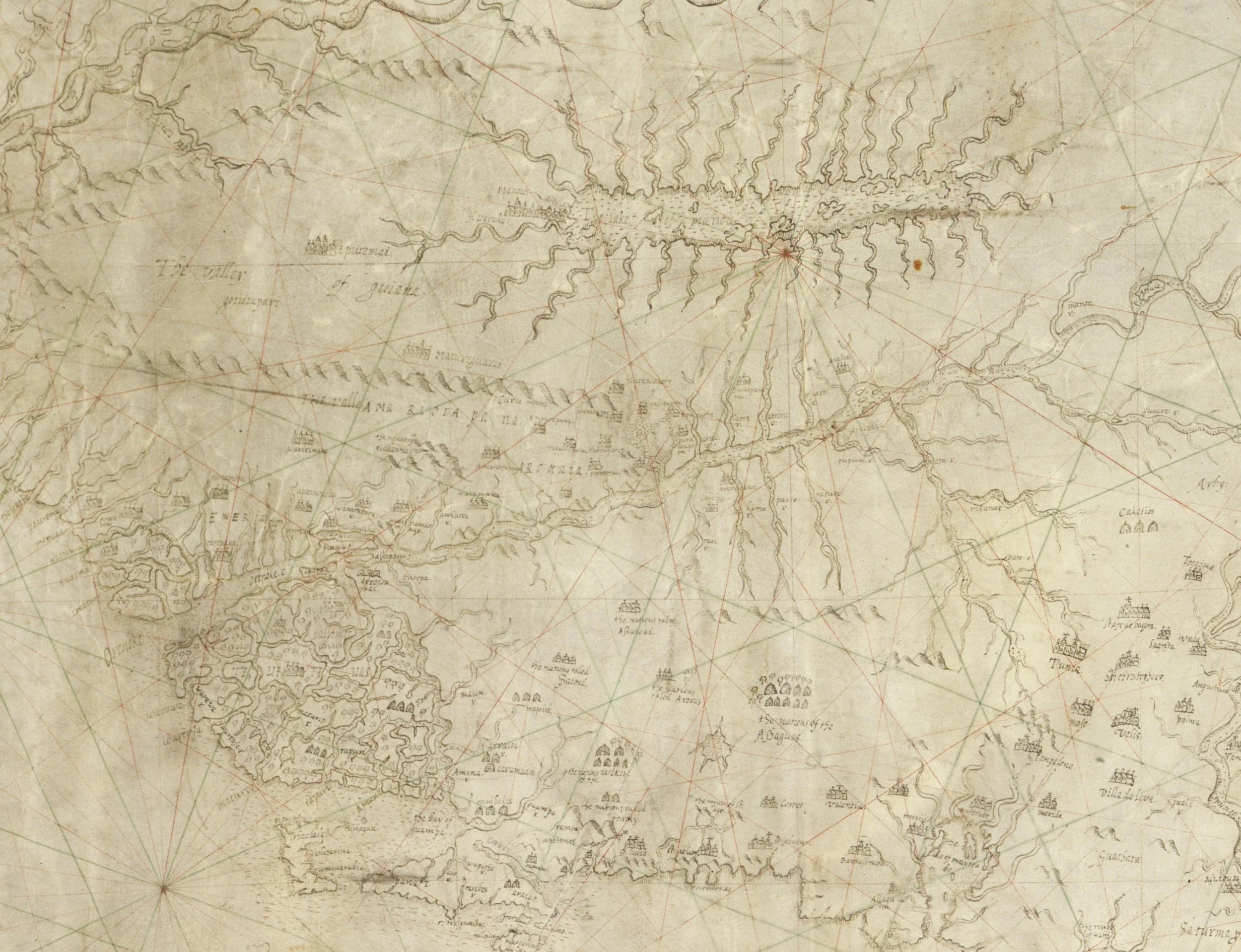
Ralegh's map of Guiana 1595
Ralegh’s map of Guiana 1595
One of the highlights for me of researching The Quest for El Dorado was going to the Manuscripts Reading Room of the British Library and handling the vellum map of Guiana made by Sir Walter Ralegh in 1595, shortly after his return from his first Guiana expedition (British Library, Add. MS 17940A; also Catalogue of Early English Manuscripts, *RaW 1031). It seems likely that the map was drawn by Ralegh’s close friend Thomas Harriot but that the names were in Ralegh’s own hand – the two men may have worked on it together at Sherborne Castle, Ralegh’s home in Wiltshire, at the same time that Ralegh was writing The Discoverie of Guiana. The map has lines of latitude and longitude and was clearly intended as a nautical chart and practical guide to the places along the coast and rivers, at a time when Ralegh fully expected to make another journey in the following year. The vellum, measuring some 27 by 30 inches across, is stiff and discoloured with age, and undulates where the highlands of the Guiana interior and the mountains beyond the Amazon lie, giving it an almost three-dimensional feel. The map is of particular significance for containing the words El Dorado in Ralegh’s own hand - the first time those words had been set down in a document in English that has survived. It is reproduced here under License from the British Library (from the British Library Collection, © The British Library Board, Add. MS 17940A).
Ralegh’s 1595 map of Guiana, looking south (a cartographic convention at the time). It extends from the Amazon river in the south around the northern coast of South America to the Pacific shore in the west, encompassing the Spanish Viceroyalty of Peru and the unclaimed lands of Amazonia and Guiana to the east (from the British Library Collection, © The British Library Board, Add. MS 17940A).
A close-up of Ralegh’s 1595 map of Guiana showing the extent of his expedition earlier that year, from Trinidad in the north (at the bottom of the map) to the mouth of the Orinoco and his furthest point some 400 miles along the river, north of the place where he located Lake Manoa - the huge lake with many tributaries at the top of the image - and El Dorado (from the British Library Collection, © The British Library Board, Add. MS 17940A).
A detail of Ralegh’s 1595 map of Guiana showing the island of Trinidad and the complex waterways of the Orinoco delta, including the Amana river south-west of Trinidad where he had set off for the interior with his expedition earlier that year. This part of the map is remarkably accurate and based closely on Ralegh’s personal experience, fresh in his memory from only a few months before (from the British Library Collection, © The British Library Board, Add. MS 17940A).
A detail of Ralegh’s 1595 map of Guiana, showing the conjectural Lake Manoa and to the left of it the city of Manoa, also called El Dorado. For me, touching those words in Ralegh’s handwriting on the map was an exciting connection to the dream that propelled him through the rest of his life, and to the reality in his mind of the place that he had positioned so confidently on this map (from the British Library Collection, © The British Library Board, Add. MS 17940A).