The Rill Cove wreck
THE RILL COVE treasure WRECK
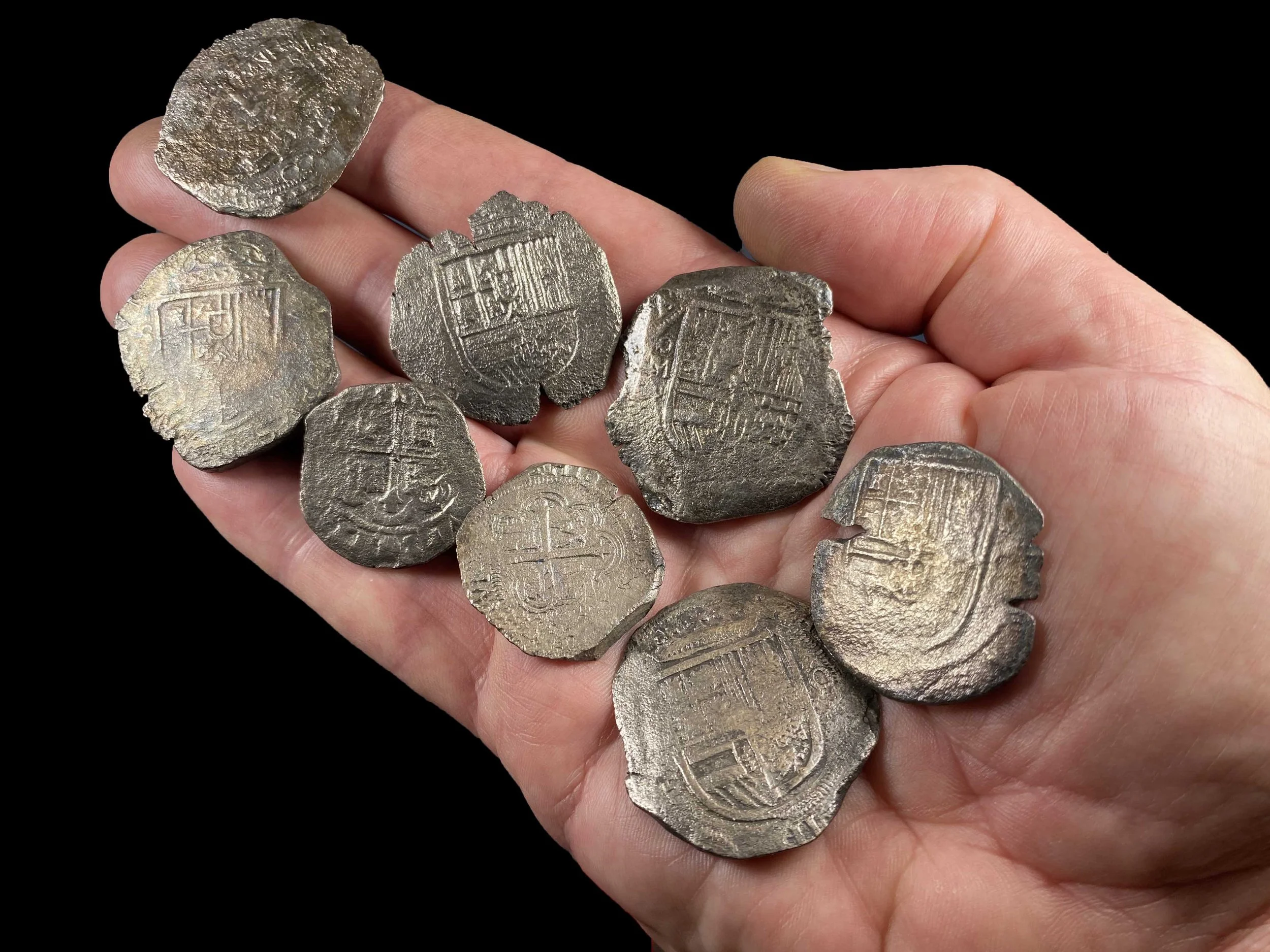
While I was writing The Quest for El Dorado, I was also diving on a wreck off south-west Cornwall dating very close to Sir Walter Ralegh's second Guiana expedition in 1617-18 and within sight of the route that his ships followed past the Lizard Peninsula into the Atlantic. More than 5,000 silver pieces of eight having been discovered at the site since divers first reported it in 1975. Seeing these coins, many from mints in the Spanish New World - including one from Lima in Peru that I describe in the book - gave me a strong sense of the lure of riches that spurred Ralegh and his contemporaries, with all of the coins having been minted during his lifetime and those from the 'Spanish Main' having been brought to Europe in the treasure fleets that were the dream of English privateers during the war against Spain in the late 16th century.
Many of the coins such as those in the banner photo are from the Mexico mint (with the mint mark oM), established soon after the Spanish conquered the Aztecs in the early 16th century, and date from the reigns of Philip II and Philip III. The earliest may be the Lima coin, dated to the late 1580s, and the latest a piece of eight from Seville in Spain bearing the date 1615. The ship may have been one described in the State Papers Domestic for 1628 in an application for salvage rights to the Lord High Admiral by Captain John Mason and Jacob Johnson, a Dutch wreck diver: 'About nine years before, a ship from St. Lucar was wrecked at the Lizard, laden with silver in bars and pieces of eight. The Cornish men, under Sir John Killigrew, have recovered certain parts of the cargo, and threaten death to all persons who attempt to seek after the remainder. The applicants pray the Duke to give them authority to recover the same.'
The ‘ship from St Lucar’ was thought to have been Dutch in origin and returning to Holland with a cargo of Spanish bullion and coin. 'St. Lucar', present day Sanlúcar de Barrameda, was an outport of Cadiz near the mouth of the Guadalcuivir river, and the last call for many Spanish ships sailing into the Atlantic. Other artefacts from the wreck include lead balls for large-bore muskets favoured by the Spanish. The finds shown in the photos below give an excellent idea of the equipment in ships in Ralegh's expeditions, including breech-loading and muzzle-loading cannon, a unique gunner's bronze measuring rod for determining the gauge of cannon shot and a beautiful pair of nautical dividers, one of the finest and oldest ever recovered from a shipwreck - exactly the type of equipment that Ralegh and his sailing masters would have used to chart their progress across the Atlantic.
The wreck is designated under the UK Protection of Wrecks Act 1973, and I am licensed by Historic England to carry out survey at the site. Many artefacts were raised by the original licensees Mike Hall and Ken Simpson in 1975-92. You can read a detailed account by Kevin Camidge of the site up to 2013 in a report for English Heritage and see a finds inventory at the Archaeological Data Service. The site only 5 to 10 metres deep and exposed to severe westerly weather off the Atlantic; it is often buried under several metres of sand and is difficult to access, with the nearest boat launch points being several miles away. Along with our dives on other sites off the Lizard Peninsula, I report ongoing diving on the wreck on my Facebook page Cornwall Maritime Archaeology. Every winter the storms shift the sand and we never know what we'll see on our first dives in the spring, so there is always the possibility of exciting new discoveries!
Click on the images to enlarge.
A view looking west over the Atlantic from Kynance Cove towards Rill Point some 700 metres away, with the cliffs rising nearly 60 metres. Rill Cove and the wreck lie immediately beneath the cliffs on this side of the point. The breaking groundswell is characteristic of this coast and makes it dangerous or impossible to dive except in very calm conditions (photo: David Gibbins).
An underwater view of the wreck site, taken about two metres out from the cliff face in five metres depth looking towards the open sea. A large bank of sand at least three metres deep can be seen piled up against the boulders that lie along the shoreline, the result of winter storms that can increase or reduce the depth of sand by several metres. Bedrock lies up to two metres below the rocks visible in this image, illustrating the extreme difficulty of excavation when the site was worked in 1975-94 - most of the coins lay in clefts and gullies in the bedrock and could only be reached by using water-dredges to clear the sand and explosives to shatter the boulders lying over them (photo: David Gibbins).
The breech end of a small cast-iron gun at the site, so worn that the bore is exposed (photo: David Gibbins).
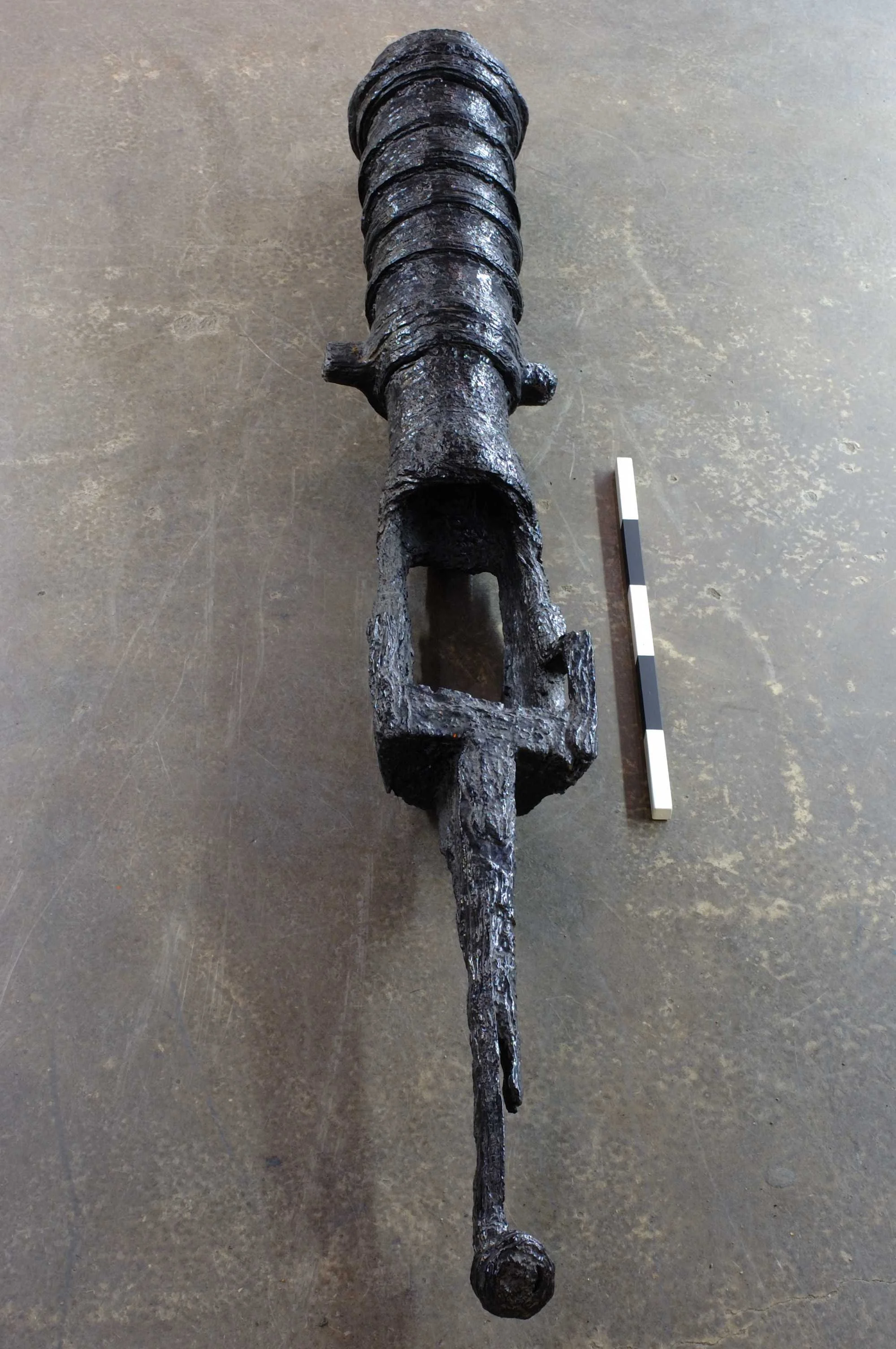
A wrought-iron ‘banded’ gun from the wreck, photographed in the now-defunct Charlestown Shipwreck Museum in 2006. The gun measures 1.63 metres in length (including the tiller) and 15 cm in maximum width, and has a bore near the muzzle of about 11.5 cm. Mounted on a swivel on the ship’s rail, the gun was operated by slotting a pre-loaded chamber (now missing) into the aperture at the breech and aimed by moving the tiller. The breeches on these guns leaked gas and they did not have had the power to inflict much damage on a ship’s hull, but they were effective anti-personnel weapons - sometimes loaded with nails and scrap iron - and earned their nickname as ‘murtherers’ (photo: Kevin Camidge).
A pair of copper-alloy nautical dividers from the wreck, used to measure and transfer distances on charts. These dividers, 11.5 cm long, are among the finest to have been found from a wreck of this period, and are similar to a pair from the Mary Rose (1545) (photo: David Gibbins).
In The Quest for El Dorado I describe standing on the clifftop above the wreck at the Rill Point cairn and holding this silver 8 reales coin - a piece of eight - from the Lima mint in Peru. Like most other coins from the wreck, it is very worn from more than four centuries in the sea, but you can make out the main features. In the centre is the crowned shield showing the territories ruled by the Hapsburg dynasty of Spain under Philip II - the castles and lions of Castile and León in the upper left quarter, and in the other parts the symbols of Aragon and Granada, Burgundy, Tirol and Austria, Brabant and Flanders and Naples and Sicily. The legend around the edge only party survives but once read PHILIPVS D G HISPANIARUM ET INDIARUM REX, ‘Philip, by the Grace of God King of Spain and the Indies’. On the left side of the shield is the letter P, for Peru, and below that 8, for 8 reales; on the right side is the letter D below a star and a little o. D was Diego de la Torre, an assayer in Lima who was active from 1577-1588, meaning that this coin is one of the oldest from the wreck and was minted shortly before or in the year of the Spanish Armada of 1588.
A rough-cast hemispherical (plano-convex) ingot of copper from the wreck, measuring 20 by 6 cm and weighing 19.25 kg. This is the only ingot known from the wreck and may be part of a larger consignment that was salvaged or remains at the site. It is a particularly interesting find as few wreck ingots of this type and date have been studied. Smelted copper of high purity could be used as a form of trading currency (photo: David Gibbins).
Two sounding leads from the wreck, one 40 by 5 cm and 10.52 lbs and the other 26.3 by 4.8 cm and 6.03 lbs, both with line attachment holes and one with a circular tallow hole in the base used to pick up a sample of the seabed - the discovery of sand often meaning a nearby shore. Sounding for depth is frequently noted by Ralegh and other captains in their journals, and was vital in the shoals and river estuaries off the shore of Guiana (photo: David Gibbins).
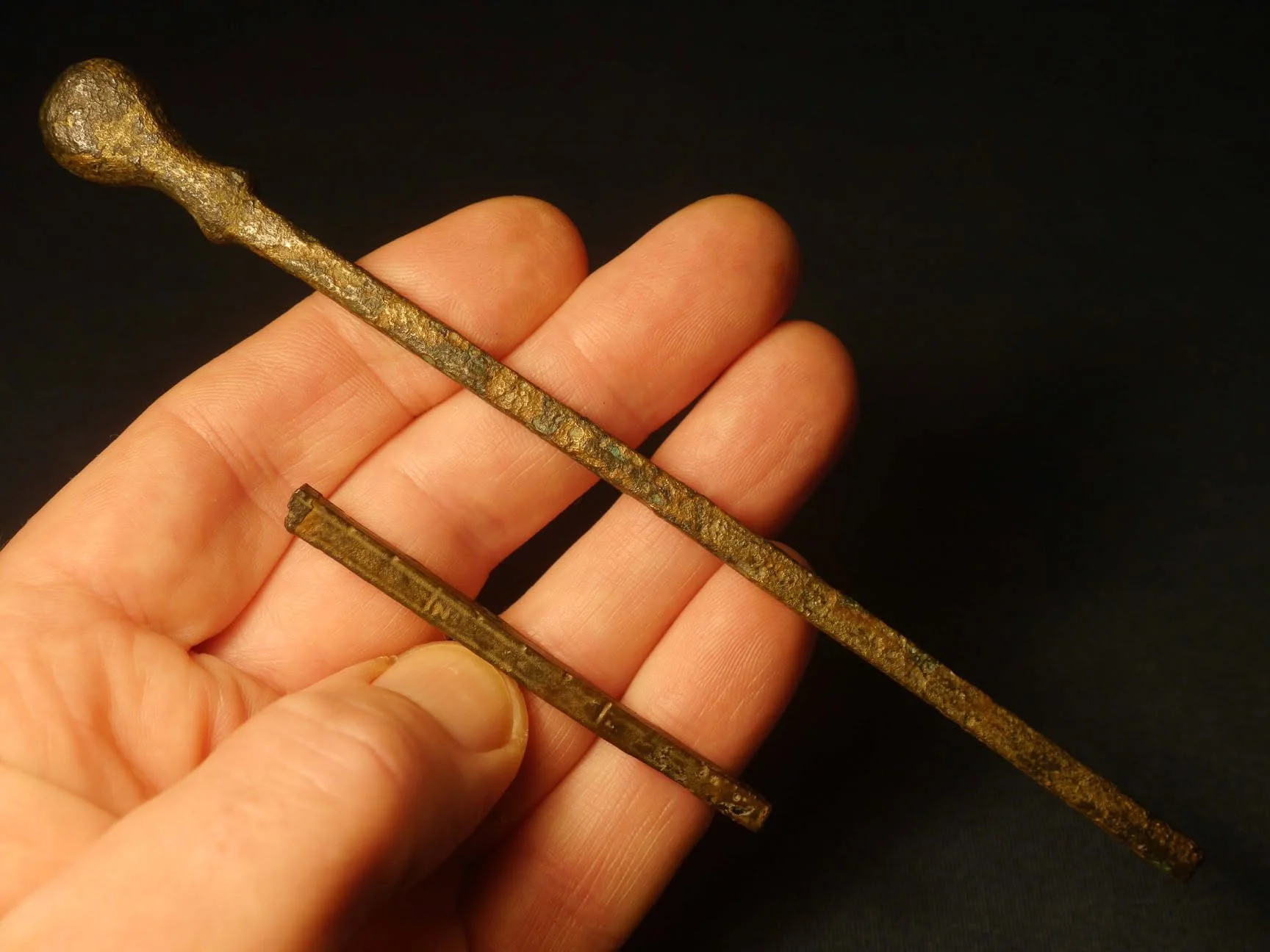
A very rare copper-alloy gunner’s rule or tally stick, found broken in two pieces on the wreck. This was designed to give the weight of shot from a measurement of its diameter - one side (facing upwards on the smaller piece) is graduated in inches, and the other three sides would have shown the weight of shot of iron, stone and lead. These instruments were particularly useful in the early period of gunnery when there were many different calibres of gun and different materials used for shot. A similar gunner's gauge, dated 1612 - close to the likely date of the Rill Cove wreck -and thought to be of German manufacture is in the History of Science Museum in Oxford (photo: David Gibbins).
A wooden sheave from the wreck, measuring 9.6 by 1.6 cm with the inner hole 1.68 cm across. A sheave was the wheel within a block on which the rope travelled in a groove around the outer edge, almost entirely worn away here. Fascinatingly, the sheave is made from lignum vitae, the prized hardwood acquired in the forests of northern South America - including Guiana - and on the Caribbean islands, so is wood that could have originated in the area of Ralegh’s expeditions (photo: David Gibbins).
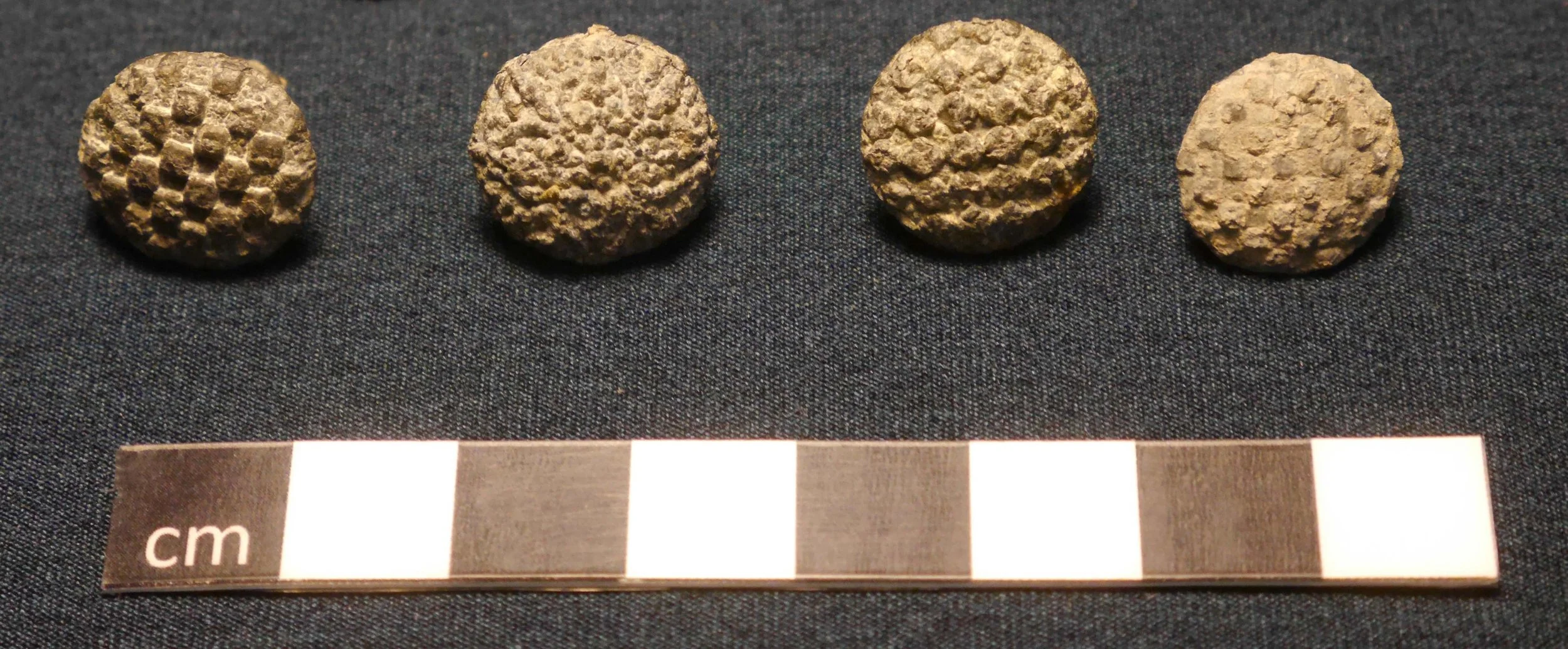
Pewter clothing buttons from the wreck, decorated with patterns of raised circles and squares and a floral pattern. These are rare artefacts from this site representing the personal belongings and accoutrements of people on board (photo: David Gibbins).
Musket balls from the wreck. With a maximum diameter of 21.7 cm, or .854 inches, these are larger than the typical English musket shot of the period (the standardised ‘Brown Bess’ shot of the 18th century was .69 to .71 inch diameter, for a bore of .75 inch). Large-bore muskets were developed by the Spanish in the 16th century to punch through armour, and were more effective in engagements at sea. The Spanish soldiers who fought Ralegh’s men in Guiana were probably armed with muskets of this larger calibre (photo: David Gibbins).
The site has a resident population of seals - this one was particularly inquisitive!